
Nov 02,2026
0
If you are sourcing pressure infusion bags for a hospital tender, an EMS catalogue or a distributor's private label, the part that decides your landed cost is usually not the bag. It is the gauge, the valve and the sleeve you bolt onto it. A 500 cc bag and a 3000 cc bag come off the same line; most of the gap between a cheap quote and an expensive one sits in three small components that are easy to leave unspecified — and expensive to discover after the container arrives.
This guide sets out the specification decisions a buyer actually has to make, in the order they affect price and clinical acceptance, and the points worth checking on a sample before you sign off.
What a pressure infusion bag actually does
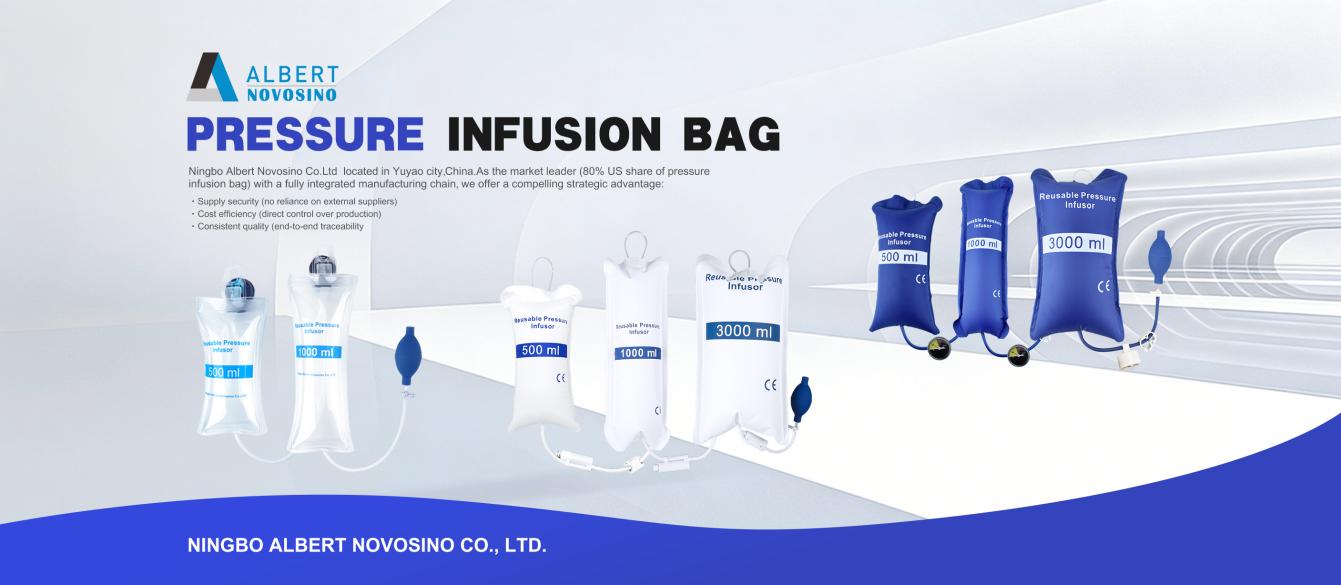
A pressure infusion bag is a cuff that wraps a fluid bag — blood, crystalloid, contrast media — and applies controlled external pressure so the fluid runs in faster than gravity alone allows. You inflate the outer sleeve with a hand bulb, read the pressure on an aneroid or piston gauge, and hold it with a valve. Typical clinical targets sit in the 150–300 mmHg range, which is why our gauges are built with a 0–300 mmHg scale rather than a narrower one: the higher end is where rapid transfusion and pressurised irrigation live.
Three situations drive the purchase. Rapid volume replacement in trauma and theatre, where a 500 cc unit can be emptied in minutes rather than the better part of an hour. Contrast media administration in imaging, where viscosity makes gravity slow. And pressure irrigation or arterial line flushing, where a steady, visible pressure matters more than speed.
The honest limitation: a pressure bag is not an infusion pump. It does not give you a programmed rate, an occlusion alarm or a documented flow log. If your protocol needs those, you are buying a pump and a bag is a companion, not a substitute. Buyers who understand this distinction stop asking a bag to do a pump's job, and stop rejecting good bags for failing at it.
The three decisions that define a pressure infusion bag order
Almost every specification argument comes back to capacity, gauge and valve. Settle these three before you ask for a price, and the quotation becomes comparable across suppliers instead of a set of numbers you cannot line up.
Bag capacity: 500 cc, 1000 cc and 3000 cc
Capacity is chosen by procedure, not by preference. 500 cc suits rapid push of a single unit of blood or a small bolus where the bag must stay light and hang high on a crowded pole. 1000 cc is the general ward and theatre workhorse — the size most tenders specify in volume, because it holds a standard fluid bag without slack and still fits a standard IV pole loop. 3000 cc exists for irrigation and for high-volume procedures where changing bags mid-case is the thing you are trying to avoid; it is heavier when full and needs a pole that will take the load.
Two further choices sit underneath capacity. Disposable or reusable: disposables remove cross-infection cleaning work and suit single-procedure kits, reusables suit a department that will use the same bag for years and wants a replaceable-bladder style of maintenance. And bag fit: the sleeve must hold the fluid bag you actually stock, not the one in the supplier's photo. If your market uses 1000 cc glass bottles as well as soft bags, say so at quotation stage — it changes the sleeve geometry.
Pressure gauge: piston, aneroid, metal or waterproof
All four of our gauge options read on a 0–300 mmHg scale, so the difference is ergonomics, precision and environment rather than range.
The piston gauge (M1) gives 360° visibility — readable from either side of the pole, which matters in a resuscitation bay where nobody stands still — and carries a bleed valve that lets you dump pressure without disconnecting. The aneroid gauge (M2) is the conventional dial: accurate, familiar, cheapest to replace. The metal gauge (M3) is the precision option, with a minimum scale division of 2 mmHg, for buyers who need finer resolution than a printed dial gives. The waterproof piston gauge (M4) exists because clinical environments are wet: it keeps liquid out of the movement without losing function.
For tender work, note that gauge type is the single most common cause of a "same product, different price" comparison. Two quotes for a 1000 cc bag can differ by a third purely because one carries M1 and the other M2.
Valve: 3-way stopcock or thumbwheel
The 3-way stopcock (A1) gives one-handed inflate, deflate and hold, which is what you want when the other hand is on the line or the patient. The thumbwheel valve (A2) is simpler: open and close, instantly, with a movement that is hard to get wrong under gloves.
There is no universal right answer. Departments that pressurise and re-pressurise repeatedly during a case tend to prefer the stopcock; departments that pressurise once and leave it prefer the thumbwheel, and buyers who have had a stopcock nudged open by a bed rail tend to prefer it too. If you are supplying a multi-site group, consider stocking both rather than arguing for one.
Sleeve material: transparent TPU or nylon mesh
The sleeve decides how the bag behaves in the hand. Transparent TPU lets staff see the fluid level and any label on the inner bag without opening the cuff, has high friction so it does not slide on a polished pole or a draped patient, and wipes clean. It is the default for theatre and imaging. Nylon mesh has noticeably less resistance, so inflation and deflation take fewer bulb strokes and the bag settles faster — a real advantage for high-turnover departments and for staff with weaker grip.
Both are made without natural rubber latex, which is a hard requirement in most Western markets and a frequent tender exclusion. Beyond material, the structural details carry more weight than buyers expect: fluid bag hooks, an IV pole loop with extended suspension so the bag hangs below the pole clamp rather than fouling it, and security clamps that stop the whole assembly sliding down. These are the parts that fail first in service, and the parts a clinical evaluation will notice.
How to read a configuration code
Our part numbers are built to be read by the person raising the purchase order, not just by the factory. A code such as S500.A1M1B2F1 reads left to right as capacity, then valve, then gauge, then sleeve: a 500 cc bag with a 3-way stopcock, piston gauge and transparent TPU sleeve. Change any segment and you have specified a different product, which is exactly the point — it removes the ambiguity that produces wrong shipments.
Two practical rules. First, put the full code on the PO and on the inner box label, not just the description; warehouse staff match codes faster than prose, and a code survives translation into a market where the description does not. Second, when you compare suppliers, ask each one to quote against the same code string. A quote you cannot decode is not a quote, it is an opening position. Where a segment is not yet decided — packing format, for instance — leave it to be confirmed on the quotation rather than guessed at, and have the supplier write the confirmed code back to you in the offer.
What to check before you approve a sample
Samples are where specification errors get caught cheaply. Work through this list with the bag in your hands, and do it before the trial batch, not after.
Pressure integrity. Inflate to the top of the scale, hold for several minutes, and watch the needle. Any creep means a leaking seam, valve seat or bulb connection. Every bag we ship is leak-tested after assembly, but a bag that survived the factory can still be damaged in transit, and your sample is also a test of the packaging.
Gauge readability. Read it at arm's length, at an angle, and with a glove on. A dial that is legible on a bench is not necessarily legible on a pole at 1.8 m with a wet glove.
Valve feel. Operate it twenty times. Stiffness that feels reassuring at first often becomes a complaint in month three; looseness is worse, because it means pressure drift.
Sleeve fit. Load the actual fluid bag you stock, not a stand-in. Check that the bag does not ride up, that the hook takes the load without the sleeve twisting, and that the pole loop clears your standard clamp.
Assembly and finish. Look at seams, burrs on moulded parts, and whether the bulb hose kinks at the joint. These are the failure points that generate warranty claims.
Documentation. Confirm which certificates come with the shipment and whether their scope covers the exact product family you are buying.
MOQ, lead time and the paperwork importers ask for
Standard lead time is 15–30 days for standard packaging and 30–50 days for customised packaging, from confirmation rather than from enquiry — so the clock starts when artwork and code are agreed, which is why buyers who finalise packaging early ship first. Minimum order quantity depends on configuration and packing: a plain bag in a polybag is a different proposition from a printed colour box with a market-specific label, and mixing capacities in one order is usually the cheapest way to reach a workable volume.
On documentation, be specific about what you need rather than asking for "all certificates". We work to ISO 13485 for quality management and hold CE and FDA documentation for the relevant product families. What that means in practice differs by market and by SKU, and it is worth being precise: an ISO 13485 certificate evidences a quality system, not a product approval; CE marking is a manufacturer's declaration against the applicable directive or regulation; FDA establishment registration is about the facility, and is not the same thing as a 510(k) clearance. If your importer needs a 510(k), say so before the quotation, because it changes what you can sell and on what timeline. Our article on FDA registration versus 510(k) clearance sets out the difference; the same discipline applies to Canadian and EU paperwork.
Frequently asked questions
What pressure should a pressure infusion bag be set to?
Most clinical protocols pressurise to between 150 and 300 mmHg, and our gauges are scaled 0–300 mmHg to cover that range with headroom. The correct set point is a clinical decision made by the purchasing hospital, not by the manufacturer — your job as a buyer is to make sure the gauge can display and hold the range your customers use.
Can the same bag be used for blood and for contrast media?
The bag is agnostic about what sits inside the inner fluid bag; what changes is the accessory set. Contrast work usually wants a visible sleeve and a gauge that is easy to read under imaging lights, while blood administration wants a valve that can be adjusted one-handed. Specify by procedure, not by product name.
Do you make disposable and reusable versions?
Yes. Disposable types suit single-procedure kits and markets that prefer to eliminate reprocessing; reusable types suit departments that keep the bag in service and replace wear parts. Both are available in 500 cc, 1000 cc and 3000 cc, with all four gauge options and both valves.
Is the bag latex-free?
Yes — all products are made with 100% natural rubber latex-free materials. If your tender also excludes DEHP or PVC, state it at enquiry stage so the material and tubing can be confirmed against the specification rather than after the sample is approved.
Can you print our brand on the bag and the box?
Yes, and this is one of the more common reasons buyers move from trading to direct sourcing. Sleeve printing, gauge face, bulb and retail box can all carry your brand, with artwork approved before the trial batch. Allow for the longer lead time that customised packaging implies.
Send us the specification, not a description
The fastest way to get a usable quotation is to send six things: capacity, gauge type, valve type, sleeve material, packing format, and the market you are selling into. Add your target annual volume and any tender document you are bidding against, and we can tell you which configuration is the realistic one rather than quoting everything and letting you guess.
If you have not settled all six, send what you have. Our technical team works from CAD and DFM analysis and can propose a configuration against a clinical use case, then supply functional samples before any trial batch is committed. Browse the pressure infusion bag range, including the transparent TPU, white sleeve and blue sleeve options, or contact us with your specification and we will come back with a configuration, a price and a lead time against the date you actually need it.

 AR
 BG
 DA
 NL
 FI
 FR
 DE
 EL
 HI
 IT
 JA
 KO
 NO
 PL
 PT
 RO
 RU
 ES
 SV
 CA
 TL
 IW
 ID
 SL
 VI
 SQ
 ET
 GL
 HU
 TH
 TR
 GA
 BE
 BN
 SO
 HAW