
Oct 20,2026
0
Are you FDA approved?
It is the first line of half the enquiries we receive from the United States, and the honest answer is that the question contains three different questions. They have three different answers, and only one of them is about the product you are buying.
One factory, two registers
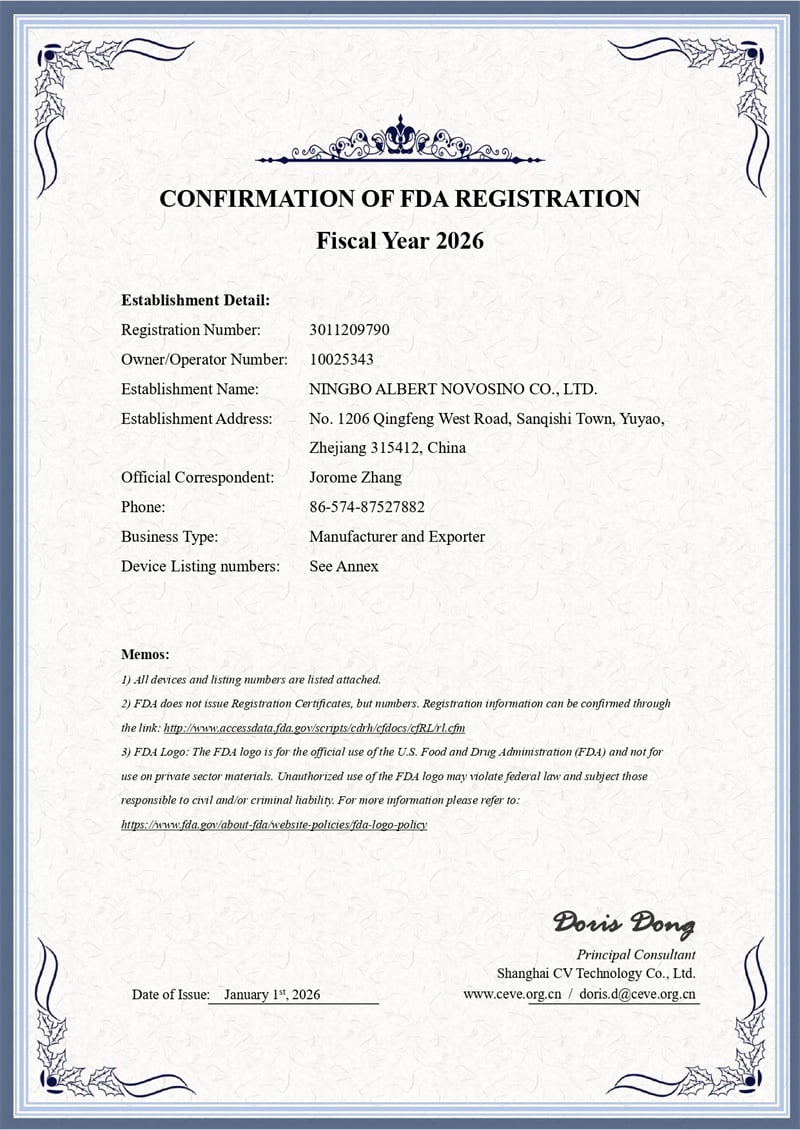
When a Chinese factory says it is "FDA registered", it usually means two administrative facts: the establishment is registered with the FDA, and the devices are listed. Both are obligations that attach to the facility. Both can be checked in the agency's public database in about two minutes.
Neither of them involves the FDA reviewing whether the product works.
Registration confirms that the factory is known to the agency, is subject to inspection, and has told the FDA what it makes. It does not certify the design, the material, or the sterility of any individual item. And because no FDA process issues an "approval" for devices of this class, the phrase "FDA approved" is not a status — it is a translation habit, and it should make you read the rest of the quotation more carefully.
What 510(k) actually is
A 510(k) is a premarket submission. The manufacturer shows that a device is substantially equivalent to a predicate device already legally on the US market, and the FDA issues a clearance letter.
The critical word is device. A 510(k) covers a named device with a stated intended use, and usually a stated set of sizes or models. It does not travel across a catalogue.
This is where suppliers most often let a buyer assume too much: a factory that holds one 510(k) will describe itself as "FDA cleared" on every product page, and the buyer discovers the gap only when a US customer asks for the clearance number on the item they actually ordered.
The comparison, in one table
| What you are told | What it proves | What to ask for |
| "FDA registered" | Facility registration + device listing | Registration number and the listing that matches your item |
| "FDA approved" | Nothing — no such status for these classes | Ask which process they mean |
| "510(k) cleared" | One named device passed premarket review | 510(k) number, device name, intended use |
Where we stand
We would rather be checked than believed:
FDA establishment registration — held for the facility, covering all our product lines. This is registration, not product approval.
FDA 510(k) — cleared for blood pressure cuffs only.
Not held — there is no 510(k) on our pressure infusion bags, ear bulb syringes, nasal aspirators, enema kits or industrial test plugs.
That last line costs us enquiries. It is also the line that tells a serious buyer how the rest of our paperwork behaves. If your US customer's file requires a 510(k) on infusion bags, we will say so before you quote, not after you have won the order.
How to check any supplier in two minutes
Search the facility in the FDA establishment database. The registration must be active — expired registrations still appear.
Search the 510(k) database by number, then read the device name, not the company name.
Ask one specification question you already know the answer to. A supplier who guesses has not read their own file.
Registration is about the factory. Clearance is about one product. A supplier who can keep the two apart is usually the one whose shipment documents also match.

 AR
 BG
 DA
 NL
 FI
 FR
 DE
 EL
 HI
 IT
 JA
 KO
 NO
 PL
 PT
 RO
 RU
 ES
 SV
 CA
 TL
 IW
 ID
 SL
 VI
 SQ
 ET
 GL
 HU
 TH
 TR
 GA
 BE
 BN
 SO
 HAW