
Nov 09,2026
0
Level one: the site
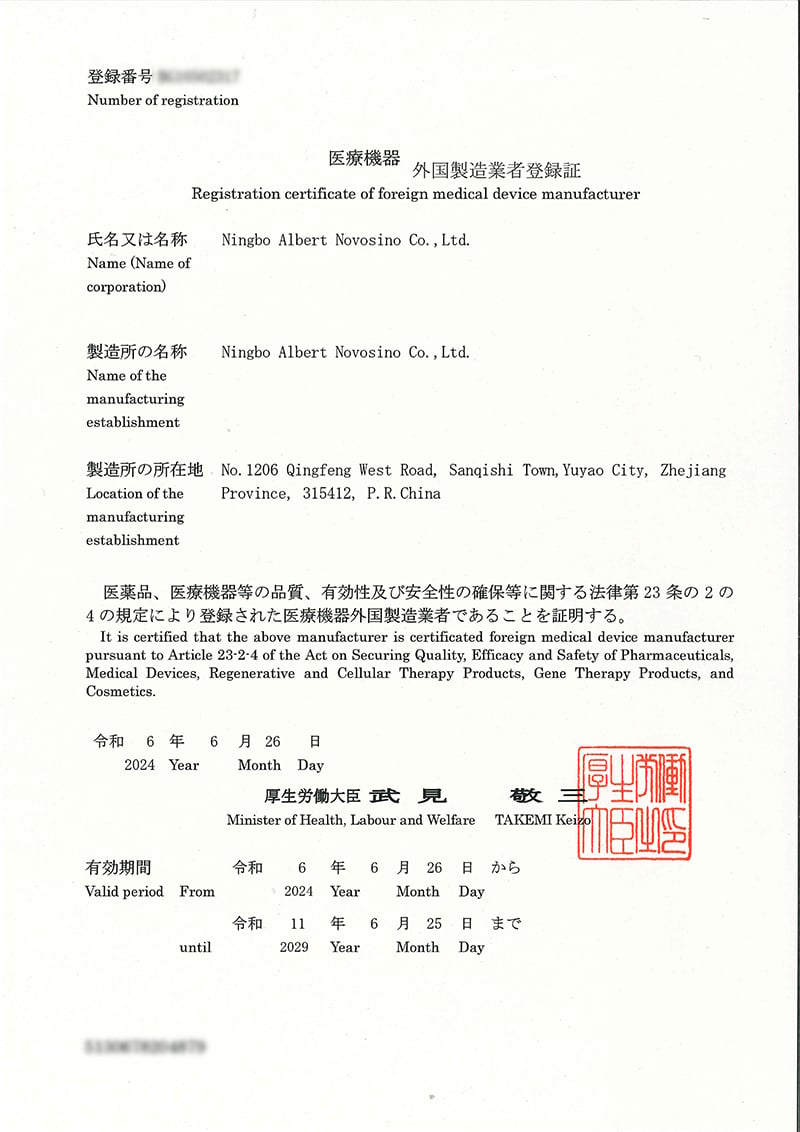
A Registration Certificate of Foreign Medical Device Manufacturer (外国製造業者登録証) is issued by the Minister of Health, Labour and Welfare to an overseas manufacturing establishment, under Article 23-2-4 of the Pharmaceuticals and Medical Devices Act.
Three things are worth noticing about this document:
●It is issued to the factory, in the factory's own name, with the manufacturing address printed on it. It is one of the few Japanese documents an overseas manufacturer can hold directly.
●It is valid for five years and must be renewed. A buyer can check currency on the face of the certificate — which is exactly what a diligent regulatory person will do.
●It names no products. There is no device list, no model number, no intended use on it. It registers the site, not what comes out of it.
That last point is where the misunderstanding starts. A registration certificate is evidence that the establishment is registered and subject to supervision. It is not an approval of any device, and it does not by itself allow a product to be sold in Japan.
Level two: the product
Marketing authorisation for an individual device is held by a Japanese marketing authorisation holder (製造販売業者, MAH) — a company established in Japan, holding its own licence. The route depends on class:
| Route | Japanese term | Applies to | Held by |
| Approval | 承認 | Class III and IV | MAH, after PMDA review |
| Certification | 認証 | Class II | MAH, via a registered certification body |
| Notification | 届出 | Class I (general devices) | MAH, filed with PMDA |
So the two levels answer different questions. The factory paper answers "is this site registered?" The product paper answers "may this device be sold here, and by whom?" A shipment needs both, and they never arrive in the same envelope.
Where we stand
Our manufacturing site holds a Registration Certificate of Foreign Medical Device Manufacturer, issued by the Ministry of Health, Labour and Welfare under Article 23-2-4, valid from 26 June 2024 to 25 June 2029. The certificate is in our own name, with our Yuyao manufacturing address.
At product level, our ear bulb syringe is the only product line registered in Japan, through our Japanese marketing authorisation holder 【MAH 名称】 under 【届出 / 認証 — 待确认】.
Our other product lines are not registered in Japan. We do not describe them as Japan-registered, and we would rather lose an enquiry than let a distributor plan a launch around a document that does not exist.
Why the distinction protects you
Two failure modes recur, and both are visible in advance:
The supplier shows a facility certificate as if it were a product approval. Ask for the device name on the paper. There isn't one.
The importer holds a product registration but the site is not registered. Then the MAH cannot file, or the filing stalls — and the delay lands on your launch date, not on the factory's.
Five questions that settle it
1. Is the certificate a facility registration or a product registration?
2. Whose name is on it — the factory, or a Japanese company?
3. What is the validity period, and does it cover your delivery window?
4. Which route was used at product level — 承認, 認証 or 届出?
5. If the product route is 届出, who is the MAH, and who maintains the technical file after launch?
A supplier who can answer question one without checking is a supplier who has read their own paperwork. That is a surprisingly strong filter.

 AR
 BG
 DA
 NL
 FI
 FR
 DE
 EL
 HI
 IT
 JA
 KO
 NO
 PL
 PT
 RO
 RU
 ES
 SV
 CA
 TL
 IW
 ID
 SL
 VI
 SQ
 ET
 GL
 HU
 TH
 TR
 GA
 BE
 BN
 SO
 HAW