
Oct 28,2026
0
Ask a European distributor what they need from an overseas manufacturer and the answer often comes back as "CE". Ask what document they want to see and it becomes "the DoC". These are not the same request, and the gap between them is where compliance files go wrong.
The document is a declaration, not a test report
Under Regulation (EU) 2017/745, the manufacturer draws up a Declaration of Conformity and takes legal responsibility for the statement it contains. It is the manufacturer speaking, on their own authority, about their own product.
That is not a weakness — it is the design. European law puts the responsibility on the party that controls the design and production. But it does mean the DoC is only as good as the quality system behind it, and it explains why the DoC is read together with the ISO 13485 certificate, never instead of it.
Classification decides how much is behind it
Whether a third party was involved depends on the device class, and the class is stated on the declaration itself:
| Class | Who assesses conformity | What the DoC shows |
| Class I | The manufacturer, self-declared | Manufacturer's name and signature, no notified body number |
| Class IIa and above | A notified body must be involved | The body's four-digit number appears on the DoC |
So the first thing to read on any DoC is not the product name — it is the classification line. A DoC that states Class IIa without a notified body number is either misclassified or incomplete. A DoC that states Class I and carries no body number is exactly what it should be.
This is also why the loose phrase "CE certified" is worth questioning. There is no single certificate that covers a device. What exists is a declaration, a technical file, and — where the class requires it — a notified body's assessment. "CE certified" describes none of them precisely.
What a complete DoC contains
The manufacturer's name and address, and the authorised representative in the EU where applicable
A product identification that matches the label and the packing list
The regulation it is issued under — 2017/745, not the older 93/42/EEC
The classification of the device
The conformity assessment route, and the notified body number where one applies
The standards applied, by reference
Place and date of issue, and the signature of the person with authority to sign
If two of those are missing, ask for a corrected copy rather than a reassurance.
Where we stand
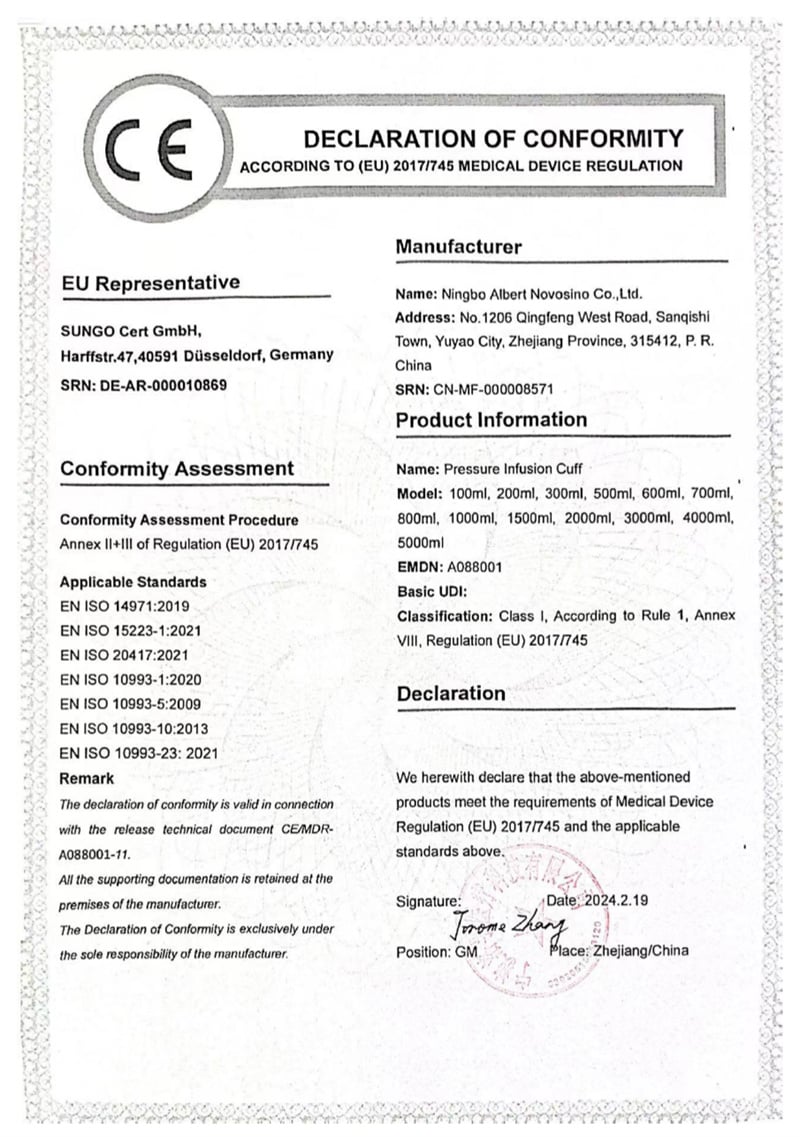
Our EU MDR Declaration of Conformity is a self-declaration issued under Regulation (EU) 2017/745. It covers:
>Pressure infusion bags
>Blood pressure cuffs
>Ear bulb syringes
>Nasal aspirators
>Enema kits
>Enema pear
>Rectal syringe
>Air cushion
>Vaginal douche
>Breast pump
>Waterproof cast cover
>Hot water bag
It does not cover our industrial inflatable pipe plug, which is not a medical device and is sold without medical claims.
Two limits we state plainly, because a buyer will discover them anyway:
The DoC is a declaration, not a third-party certificate. If your file requires a notified body assessment for a higher class, that is a different route and we will map the gap with you before you commit.
We do not describe our products as "CE certified". The accurate description is what the document says: a Declaration of Conformity under EU MDR.
How to review a DoC in five minutes
1.Check the regulation year — 2017/745 means current; 93/42/EEC means the document predates the transition.
2.Read the classification, then look for a notified body number if the class requires one.
3.Match the product identification against the label on the carton, not against the website.
4.Check the signatory has a title that could plausibly carry authority — a sales email address is not a signature.
A declaration is a promise with a name on it. Read the name, and read the class.

 AR
 BG
 DA
 NL
 FI
 FR
 DE
 EL
 HI
 IT
 JA
 KO
 NO
 PL
 PT
 RO
 RU
 ES
 SV
 CA
 TL
 IW
 ID
 SL
 VI
 SQ
 ET
 GL
 HU
 TH
 TR
 GA
 BE
 BN
 SO
 HAW