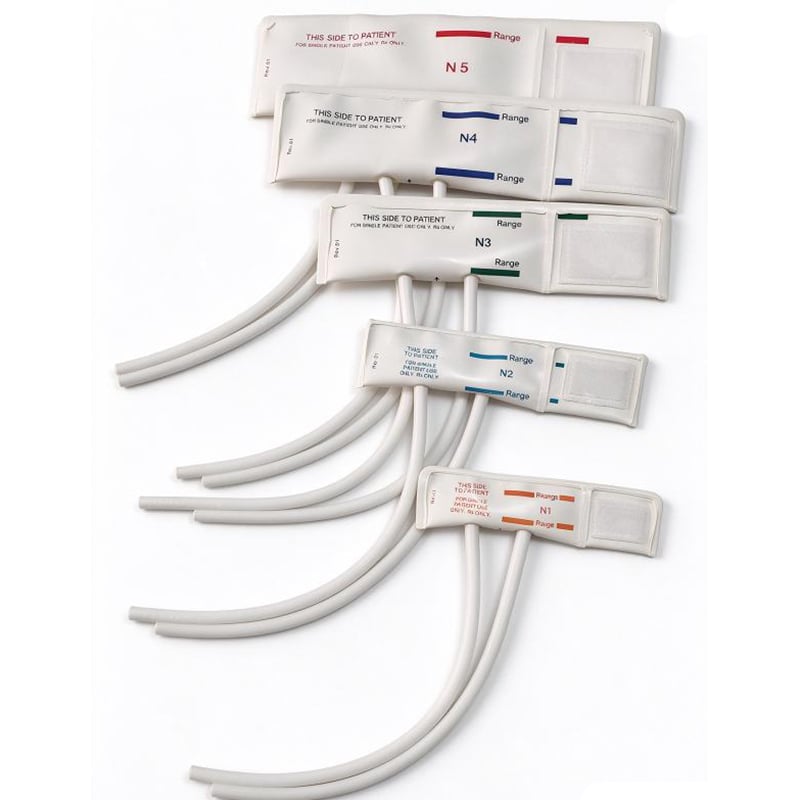
| Model | Limb circumference | Size | Tube |
| N1ST / N1DT | 3–6 cm | 1# | Single / double |
| N2ST / N2DT | 4–8 cm | 2# | Single / double |
| N3ST / N3DT | 6–11 cm | 3# | Single / double |
| N4ST / N4DT | 7–13 cm | 4# | Single / double |
| N5ST / N5DT | 8–15 cm | 5# | Single / double |
Most veterinary blood pressure readings that look wrong are not a monitor fault. They are a cuff fault — the wrong size on the limb, a tube that does not seal, or a cuff that has stiffened after a year of clinic cleaning. For a distributor, that is the useful commercial fact in this category: cuffs are a consumable that gets reordered because it fails or runs out, not because a clinic has decided to upgrade.
This guide covers what a veterinary NIBP cuff has to do, how the N1–N5 size set maps onto real limbs, what the material specification actually means in a clinic, and how to build an order that reorders cleanly.
An oscillometric monitor infers systolic, mean and diastolic pressure from tiny pressure oscillations in the cuff. Those oscillations are small — a fraction of the pressure step the monitor is applying — so the geometry of the cuff decides whether the signal is readable at all. A cuff that is too narrow for the limb over-occludes, and the monitor reports a pressure that is falsely high. A cuff that is too wide under-occludes, the oscillations flatten, and the reading drifts low or the monitor simply errors out. Neither failure looks like a cuff problem on the screen. Both get blamed on the machine, on patient movement, or on "cats being cats".
The second failure mode is mechanical. Veterinary cuffs live in a environment that human NIBP cuffs do not: fur, claws, teeth, alcohol wipes, chlorhexidine, and a cage door that closes on the tubing. A cuff that is not built for that returns as a complaint within months, and a distributor who supplies it spends the margin on replacements.
The third is connector mismatch. A cuff is only as good as the join between its tube and the monitor's hose. Clinics run mixed equipment — one monitor brand in theatre, another in the consult room, a third on loan — and a cuff that fits one and not the other creates a stock problem the clinic will solve by buying from whoever solves it for them.
Our veterinary and neonatal cuffs are one product family, offered in five sizes with a choice of single or double tube. The printed range is the intended limb circumference, so sizing starts with a tape measure rather than a guess.
Read the overlaps carefully, because they are deliberate. Sizes 1 and 2 exist for the smallest patients — neonatal use and the smallest exotic or toy-breed limbs — while sizes 3 and 4 are the working range for cats and small-to-medium dogs, and size 5 covers the forelimb of a larger dog. The overlaps let a clinic step up a size when a limb sits on a boundary and the cuff is sitting too tight, which is the single most common sizing correction in practice.
For a distributor, the commercial consequence is that the sizes do not sell in equal numbers. Sizes 3 and 4 carry the volume in small-animal practice; sizes 1 and 2 are bought in smaller quantities but are the ones that generate "do you have it in stock" calls, because a clinic that runs out cannot substitute upward without accepting a worse reading. Stock the middle sizes deep and the ends shallow but never zero.
Measure the circumference of the limb at the site where the cuff will sit, not the widest part of the leg. In practice that is the forelimb between elbow and carpus, or the hindlimb between stifle and hock, with the patient standing or in lateral recumbency and the limb relaxed. Write the number down; do not eyeball it. A 2 cm error moves a cat from size 3 to size 4.
The widely used rule of thumb in small-animal practice is that cuff width should be roughly 40% of the limb circumference. This is where the printed range on the cuff earns its keep: pick the size whose range contains your measurement, then check the width against the 40% figure. If the two disagree, trust the tighter of the two — an over-wide cuff produces a falsely low reading that is more dangerous clinically than a marginally narrow one, because hypotension gets treated when it does not exist.
Two practical notes that rarely make it into supplier literature. First, hair: a cuff placed over a thick coat reads differently from one on a clipped site, so the same patient can measure differently between visits. Second, position relative to the heart — a cuff sitting well above or below heart level shifts the reading by hydrostatic effect, which is a technique issue but will still generate a cuff complaint if your customer has not been trained on it. Good distributors ship a one-page sizing card with the first order; it costs almost nothing and it reduces returns.
Our veterinary cuffs are made with TPU, and contain no natural rubber latex, no DEHP and no PVC. Each of those exclusions answers a specific question a clinic or its regulator will ask.
TPU is the reason the cuff can be wiped rather than laundered. It resists the alcohols and disinfectants used between patients, keeps its shape after repeated inflation, and stays supple enough to conform to a limb rather than bridging over it. A cuff that bridges leaves a gap under the bladder, which reads like a cuff that is too wide. Latex-free matters for staff sensitisation and for clinics that have removed latex as a policy; DEHP and PVC exclusions matter for markets where those materials are restricted in medical devices and for clinics whose procurement policy has already moved. Being able to answer all three questions from a specification sheet, rather than from a rep's memory, is worth real time in a tender.
The rest of the build matters as much as the material. Smooth welded edges rather than stitched ones, so fur does not catch. A bladder that does not migrate inside the sleeve when a struggling patient is restrained. A tube that stays flexible at low temperatures, because a cuff that has been in a cold vehicle all morning is a cuff that will kink at the connector.
Single-tube cuffs carry one pneumatic line; the monitor's own valve handles inflation and deflation through it. Double-tube cuffs carry separate inflation and sensing lines, which some monitors require and which some clinicians prefer because the sensing line stays isolated from the pump pulses.
The specification follows the monitor, not the patient. If your customers run a mixed fleet, the pragmatic answer is to stock both variants in the sizes that move, rather than to standardise on one and field the exceptions by special order. Our cuffs are supplied with a range of connectors and adapters so the same cuff body can be fitted to different monitor hoses — which is also the cheapest way to serve a market where the installed base is fragmented across brands and vintages.
One honest caveat for anyone specifying on behalf of a clinic: connector fit is not the same as clinical validation. A cuff that physically connects will inflate and read, but cuff-and-monitor combinations are validated as a system, and the buyer's own protocol should govern which pairing is used on patients. Confirm the connector, then let the clinic's clinical lead confirm the pairing.
Minimum order quantity is 1,000 units, which is a packing-driven number more than a production one: below that, the cost of colour boxes, labels and mixed-size assortments outweighs the unit economics. Supply capacity is around 10,000 pieces per month, and standard delivery is about 30 days, from Ningbo or Shanghai, on 30% deposit with 70% balance.
For a distributor building a first order, the useful structure is an assortment rather than a single size: weight the lines toward sizes 3 and 4, include sizes 1, 2 and 5 in smaller quantities, and split single and double tube according to the monitor brands you actually sell against. Ask for each size in its own colour box or polybag — a clinic that can identify a size from the shelf without opening it will reorder the right size, which is a quieter benefit than it sounds.
Payment and shipping terms are worth settling early because they set the working-capital shape of the whole programme. A 30/70 split against a 30-day production window means your cash is committed roughly six weeks before goods are on the water; if you are supplying a tender with a fixed delivery date, work backwards from that date rather than from the order date.
Cuff bodies are visually similar across suppliers, so the differentiation a distributor can sell is the printed one: sleeve printing, size markings, the retail box, and the sizing card inside it. All of that is customisable, and artwork is approved before production, which is why buyers who know their own brand should raise it at enquiry stage rather than after the sample is approved.
The most common mistake in private-label cuff programmes is treating print as decoration. Printed size numbers that are legible at arm's length, and a box that shows the size on the end panel, do more for reorder accuracy than a logo does. If you sell into clinics with multiple branches, add a line on the box for the branch to write its own stock code — cheap, and it stops the "we ordered the wrong size" conversation permanently.
Quality documentation follows the same logic as the print. We work to ISO 13485 and hold CE and FDA documentation for the relevant product families, and can supply inspection reports and material certification with the shipment. As with any medical device, be precise about what a document proves: a quality-system certificate is not a product approval, and registration of a facility is not a clearance of a device. Match the document to the market you are registering in.
Can the same cuff be used on neonates and on animals?
Yes — this is a shared product family. The sizes are specified by limb circumference (3–15 cm), so the same N1–N5 range serves neonatal human use and small-animal veterinary use. Buyers who serve both markets can consolidate the line, though labelling and packaging should be market-specific.
Which size should a clinic start with for cats?
Size 3 (6–11 cm) covers most feline forelimbs, with size 2 (4–8 cm) for smaller patients and size 4 (7–13 cm) for larger cats and small dogs. Because the ranges overlap, the correct answer always comes from measuring the limb, not from the species.
Are the cuffs latex-free?
Yes. They are TPU, with no natural rubber latex, no DEHP and no PVC. If your market restricts additional substances, send the requirement with the enquiry so the specification can be confirmed in writing before the sample stage.
Can we order mixed sizes in one shipment?
Yes, and for a first order it is the sensible structure — weight toward the sizes that carry clinical volume and include the extremes in smaller quantities. Mixed assortments are also the cheapest way to reach the 1,000-unit minimum without over-committing to a single size.
Do you supply the monitor hoses and connectors too?
Cuffs are supplied with a range of connectors and adapters for connecting to different monitors, and we also produce BIBP monitor hoses and fittings. If you tell us the monitor brands in your market, we can advise which connector set to specify instead of shipping a universal kit that fits none of them well.
Build the first order around the sizes that reorder
Veterinary NIBP cuffs are a repeat-purchase category, and the winners in it are not the suppliers with the widest catalogue — they are the ones whose size 3 and size 4 are always in stock, whose connectors fit what the clinic already owns, and whose box makes the right size easy to pick. Get those three right and the reorder arrives without a sales call.
Send us the monitor brands you sell against, the species mix you serve, and your annual volume by size, and we will propose an assortment, a packing format and a lead time against your first delivery date. Start with the veterinary blood pressure cuff range, which carries the N1–N5 size table and connector options in one place, or the veterinary and neonatal size set if you want to see the assortment as it ships. Monitor hoses and fittings are on their own page, and the wider blood pressure cuff range covers reusable and disposable human NIBP cuffs. Or contact us with your requirement and we will confirm the specification in writing before anything is produced.


 AR
 BG
 DA
 NL
 FI
 FR
 DE
 EL
 HI
 IT
 JA
 KO
 NO
 PL
 PT
 RO
 RU
 ES
 SV
 CA
 TL
 IW
 ID
 SL
 VI
 SQ
 ET
 GL
 HU
 TH
 TR
 GA
 BE
 BN
 SO
 HAW