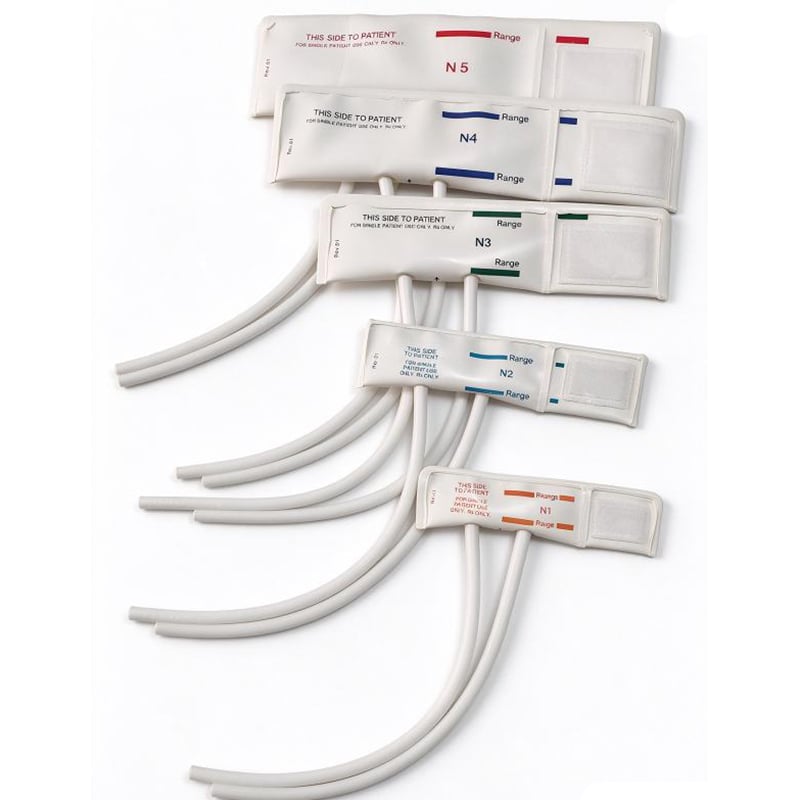
| Model | Limbcircumference | Size | Tubeoptions |
| N1ST /N1DT | 3–6cm | 1# | Single ordouble |
| N2ST /N2DT | 4–8cm | 2# | Single ordouble |
| N3ST /N3DT | 6–11cm | 3# | Single ordouble |
| N4ST /N4DT | 7–13cm | 4# | Single ordouble |
| N5ST /N5DT | 8–15cm | 5# | Single ordouble |
Veterinary NIBP cuffs in five sizes covering 3–15 cm limb circumference, for cats, small to medium dogs, and neonatal patients. 210D nylon TPU cuff, no natural rubber latex, single or double tube, ML532 male slip Luer (5/32 in barb) as standard. The same cuff platform is cleared under 510(k) K173044 as a Class II NIBP accessory. Minimum order 1,000 pieces per size, standard lead time 30 days, 10,000 pieces per month capacity.
Measure the limb where the cuff will sit — the forelimb between elbow and carpus, or the hindlimb between stifle and hock — then match the number to the range below. The ranges overlap deliberately, so a limb sitting on a boundary can move up a size when the cuff reads too tight.
Five sizes, each orderable on its own — you do not have to take the range to take one size — and sizes can be combined in a single shipment. The 1,000-piece minimum applies to each size rather than to the order, which makes a first order a narrow one: N3 and N4, the two that carry small-animal volume, is 2,000 pieces, while a full five-size range in both tube variants is 10,000, a month of capacity.
How to pick, in three steps: measure the circumference, choose the size whose range contains that number, then check that the cuff width is roughly 40% of the circumference. Where the two disagree, take the narrower cuff — an over-wide cuff reads falsely low, which is the more dangerous error clinically.
Cuffs are the part of a monitoring set that gets wiped, bitten, snagged on a cage door and left in a cold vehicle overnight. The build reflects that.
TPU construction
● — resists the alcohols and disinfectants used between patients, holds its shape after repeated inflation, and stays supple enough to conform to the limb instead of bridging over it.
210D nylon TPU cuff, no natural rubber latex
● — for clinics with latex-avoidance policies. The air hose is PVC, as recorded in the 510(k); tell us if your market restricts it.
Welded edges, not stitched
● — so fur does not catch and the seam does not fray.
Non-migrating bladder
● — stays put inside the sleeve when a patient is restrained.
Cold-flexible tubing
● — does not kink at the connector after a night in the van.
Custom printing
● — size markings, your brand on the sleeve, and a box that shows the size on the end panel.
Single tube carries one pneumatic line; the monitor's valve handles inflation and deflation through it. Double tube separates inflation from sensing, which some monitors require and some clinicians prefer because the sensing line stays isolated from pump pulses.
The specification follows the monitor, not the patient. If your customers run a mixed fleet, stock both variants in the sizes that move rather than standardising on one and fielding exceptions by special order.
Every cuff in this range terminates in a 5/32 in (4 mm) barb, and the fitting pressed onto that barb decides which monitor hose the cuff will mate with. Describing compatibility that way separates two questions buyers usually conflate: what the cuff's tube is — fixed, 8.0 mm OD with a 4.0 mm ID and a 5/32 in barb — and what coupler sits on the end, which is a choice.
The standard is ML532: male slip Luer, 5/32 in barb, nylon, item code LM-03. Four other fittings run on the same barb:
| Fitting | Type | Barb | Material | Item |
| ML532 | Male slip Luer | 5/32 in | Nylon | LM-03 |
| HP532 | Hewlett Packard type | 5/32 in | Nylon | LM-02 |
| FL532 | Female locking Luer | 5/32 in | Nylon | LM-05A |
| MQ532 | Marquette type | 5/32 in | ABS | LM-06 |
| DM532 | Dinamap type | 5/32 in | POM | LM-09 |
Same cuff, different coupler — which means one order can cover an installed base that mixes HP, Marquette and Dinamap monitors, instead of five separate SKUs. It also means the "which monitors does it fit" question has no useful answer at the model level: the answer is always the fitting.
Note what these are not. A NIBP fitting is a pneumatic push-on connector on an air hose; it is a different family from a monitor's electrical sensor ports, and it cannot mate with one whatever the model number suggests. Buyers who usually specify SpO2 accessories assume every plug on a monitor is interchangeable, and this is the specification where that assumption costs a container.
Two cautions that matter more than the table. The same monitor model can be supplied with different NIBP hose fittings by market and module configuration, so match against the hose actually in use rather than the model name on the front of the monitor. And fitting fit is not clinical validation: a cuff that physically connects will inflate and read, but cuff-and-monitor combinations are validated as a system, and the clinic's own protocol governs which pairing is used on patients.
| Item | Detail |
| Pressure range | 0–300 mmHg scale, 400 mmHg maximum |
| Max leakage | Under 4 mmHg/min |
| Tubing | OD 8.0 mm / ID 4.0 mm / length 200 mm |
| Connector |
ML532 male slip Luer, 5/32 in (4 mm) barb, nylon, item LM-03. Also available on the same barb: HP532, FL532, MQ532, DM532 |
| Size standard | N1–N5, conforming to AHA bladder size recommendations |
| Minimum order quantity | 1,000 pieces per size (not per order) |
| Supply capacity | ~10,000 pieces per month |
| Standard lead time | About 30 days |
| Port of loading | Ningbo or Shanghai |
| Payment terms | 30% deposit, 70% balance |
| Packaging | Individual colour box or polybag; mixed sizes per carton on request |
| Branding | Sleeve print, size markings, retail box, sizing card |
Lead time runs from artwork and code approval, not from enquiry — buyers who settle packing early ship first.
This cuff platform is cleared in the United States under 510(k) K173044, as a Class II non-invasive blood pressure cuff accessory under 21 CFR 870.1120, product code DXQ. The clearance covers reusable and disposable blood pressure cuffs used in conjunction with NIBP measurement systems, in infant, pediatric and adult sizes, and it was supported by testing to ISO 81060-1 and to ISO 10993-5 and -10 for cytotoxicity, irritation and sensitisation. Sizes N1–N5 are part of that cleared family and conform to AHA bladder size recommendations.
Two things this does and does not mean — a US distributor will check the FDA database, and this page should read consistently with what they find.
It means the design, materials, performance and biocompatibility of this cuff family have been reviewed against a legally marketed predicate. The 510(k) summary is available on request for your own file, tender submission or importer due diligence.
It does not mean the cuff is cleared for veterinary use. The cleared indications are human non-invasive blood pressure. FDA does not require 510(k) clearance for animal devices, so a veterinary cuff needs no clearance of its own — but it also must not be described as FDA-cleared for animals. The accurate sentence, if a customer's compliance team asks, is that the same cuff platform is 510(k) cleared for human NIBP use and is supplied for veterinary use outside those cleared indications.
Manufactured under an ISO 13485 quality management system; inspection reports and material certification ship with the goods, and the K173044 510(k) summary is available on request.
Three documents do three different jobs, and buyers who keep them apart lose less time: the ISO 13485 certificate describes the quality system, the 510(k) clearance describes the device, and CE marking is a manufacturer's declaration against the applicable EU regulation. None substitutes for another, and registration of a facility is not a clearance of a device. Tell us the market you are registering in and we will confirm which set applies to this product family before your customer starts the application.
Can the same cuff be used on neonates and on animals?
Yes — this is a shared product family. Sizes are specified by limb circumference from 3 cm to 15 cm, so the same N1–N5 range serves neonatal human use and small-animal veterinary use. Labelling and packaging are specified per market.
Which size should a clinic start with for cats?
Size 3 (6–11 cm) covers most feline forelimbs, with size 2 (4–8 cm) for smaller patients and size 4 (7–13 cm) for larger cats and small dogs. Because the ranges overlap, the correct answer comes from measuring the limb rather than from the species.
Are the cuffs latex-free?
The cuff is 210D nylon TPU with no natural rubber latex. The air hose is PVC, as recorded in the 510(k) file — so if your market restricts PVC or your customer requires a DEHP-free declaration, send the requirement with the enquiry and we will confirm the material in writing before the sample stage.
Is the veterinary cuff 510(k) cleared?
The cuff platform holds 510(k) K173044 as a Class II NIBP accessory for human use, covering infant, pediatric and adult sizes, including the N1–N5 range. The clearance does not extend to veterinary indications: FDA does not require 510(k) clearance for animal devices, so there is no veterinary clearance to hold, and we do not describe the cuff as FDA-cleared for animals. What you can rely on is the design, material and performance testing behind the file.
Can we order mixed sizes, or a private-label box?
Both. Any single size can be ordered on its own, and sizes and tube variants can be combined in one shipment — with the 1,000-piece minimum applying to each size. Sleeve print, size markings and retail box can carry your brand. Artwork is approved before production, which is why private-label buyers should raise it at enquiry stage rather than after the sample is approved.
Do you supply the monitor hoses and connectors?
Cuffs ship with ML532 — male slip Luer, 5/32 in barb — as standard, and HP532, FL532, MQ532 and DM532 fit the same barb, so the coupler can be matched to the monitor family without changing the cuff. Monitor hoses and fittings are in the same range. Tell us the fitting code or the monitor family and we will quote it; that is a specification question with a lead time attached, not something to discover at the clinic.
Send three things and we will propose the assortment. The monitor brands you sell against, the species mix you serve, and your annual volume by size. We will come back with a size breakdown, a packing format and a lead time against your first delivery date — and confirm the specification in writing before anything is produced.


 AR
 BG
 DA
 NL
 FI
 FR
 DE
 EL
 HI
 IT
 JA
 KO
 NO
 PL
 PT
 RO
 RU
 ES
 SV
 CA
 TL
 IW
 ID
 SL
 VI
 SQ
 ET
 GL
 HU
 TH
 TR
 GA
 BE
 BN
 SO
 HAW